

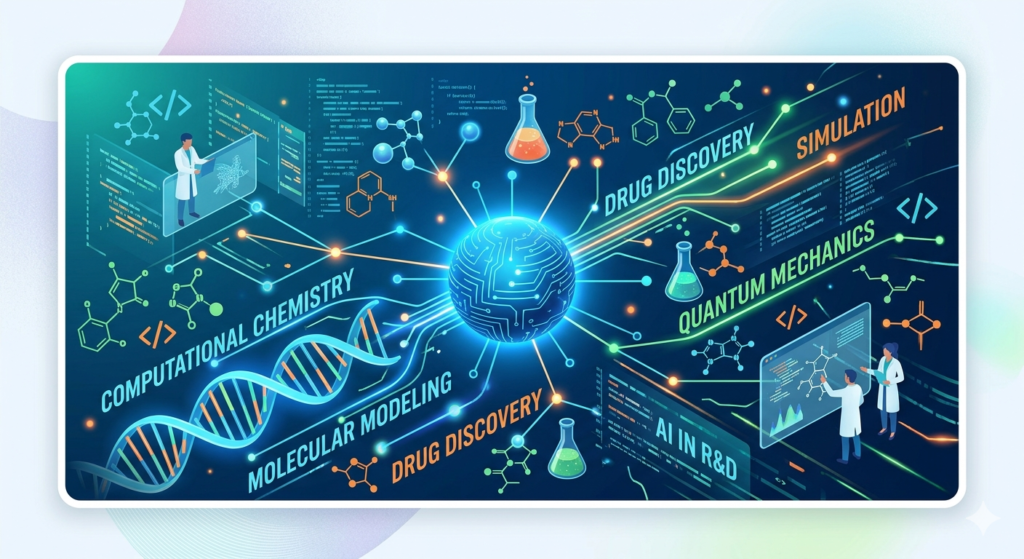
Computational chemistry has transformed the way we understand the world, moving the frontier of science from the physical laboratory to the digital realm.
1.What is Computational Chemistry?
At its simplest, computational chemistry is the use of computer simulation to solve chemical problems. It uses the fundamental laws of physics—specifically Quantum Mechanics and Classical Mechanics—to predict how atoms and molecules will behave.
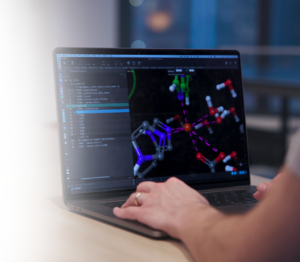
Instead of spending months synthesizing a new compound only to find it doesn’t work, scientists can now “build” that molecule in a virtual space and test its properties in seconds.
The Power of the “Virtual Lab”

1. Precision at the Atomic Scale
Experimental chemistry can tell you that a reaction happened; computational chemistry tells you how it happened. By simulating the movement of every single electron and nucleus, researchers can visualize the exact “transition state” of a chemical reaction—a moment so fleeting it is almost impossible to capture in a physical lab.
2.Tools in the Computational Chemistry Toolkit:
To model the complexity of nature, scientists use different levels of theory depending on the size of the system:
- Quantum Mechanics (QM):
Used for small systems where high accuracy is needed. It calculates electron density and energy levels using equations like the Schrödinger equation.
- Molecular Dynamics (MD):
Used for large systems like proteins or polymers. It treats atoms like “balls” and bonds like “springs” to see how they move over time.
- Machine Learning (ML):
The newest frontier. By training AI on vast databases of known chemicals, computers can now “guess” the properties of new materials with incredible speed.
3.Why the Computational chemidtry is Going “Digital-First:
For chemical suppliers and manufacturers, the shift to digital chemistry is driven by three major pain points:
- Accelerated Speed-to-Market:
Traditional R&D can take years. Computational models can screen millions of compounds in days. In an industry where being “first to patent” is everything, speed is the ultimate competitive advantage.
- Sustainability (The Circular Economy):
Designing eco-friendly materials is easier when you can simulate their environmental impact before they even exist. Computational tools help optimize reactions to use less energy and produce fewer byproducts.
4.Real-World Impact: From Batteries to Vaccines:
Computational chemistry isn’t just academic; it’s solving the world’s biggest challenges:
1.Green Energy:
Scientists use simulations to design new materials for solid-state batteries and more efficient solar cells.
2.Medicine:
During the COVID-19 pandemic, computational models were vital in understanding the structure of the spike protein and developing effective vaccines in record time.
3.Materials Science:
From scratch-resistant glass on your smartphone to lightweight alloys for fuel-efficient aircraft, digital modeling is the silent architect.
5.The Marketing Angle: Selling “Innovation-as-a-Service”
If you are marketing to chemical engineers, procurement officers, or R&D directors, your messaging shouldn’t just be about the chemicals themselves. It should be about the digital maturity behind them.
- Content Strategy:
Use data visualization and case studies that show how your simulations reduced “lab time” for a client.
- Trust & Authority:
In B2B marketing, showing that you use Density Functional Theory (DFT) or Molecular Dynamics (MD) signals that your company is at the cutting edge of technology.
- The AI Revolution:
With the rise of Machine Learning (ML), we can now predict chemical properties with 99% accuracy. Highlight your “AI-powered” research to differentiate your brand in a crowded market.
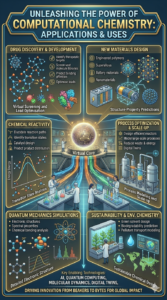
Conclusion: From Beakers to Bytes
We are entering an era where the distinction between “computer scientist” and “chemist” is blurring. As supercomputers become more powerful and algorithms more refined, our ability to engineer matter will only grow.
The beaker will always have its place, but the future of chemistry is being written in code. By merging the physical and the digital, we are unlocking a faster, cleaner, and more innovative world.






Leave a Reply