



Table of Contents
ToggleUnderstanding Business Growth Strategies:
Before diving into the tactics, it’s important to define what business growth strategies are.
Business growth strategies are structured plans and approaches designed to increase a company’s profit, request share, and overall value. These strategies encompass a wide range of conditioning, including request exploration, functional effectiveness advancements, product diversification, and client accession tactics.
Why Business Growth Strategies Matter ?
⦁ Sustainable profit Growth : A well- planned growth strategy ensures a steady increase in gains and minimizes fiscal pitfalls.
⦁ Competitive Advantage :Businesses that acclimatize and expand effectively maintain an edge over challengers.
⦁ Scalability: Growth strategies allow companies to gauge operations without compromising quality or effectiveness.
⦁ Innovation: They encourage exploring new requests, technologies, and products.
Without proper business growth strategies, companies may witness recession or indeed decline, no matter how innovative or popular their immolations are.
Key Components of a Successful Business Development Plan
A business development plan forms the backbone of any growth strategy. It acts as a roadmap, guiding businesses from their current state to unborn success.
Conducting Market Research:
Understanding your target followership is critical. Effective request exploration involves
⦁ Relating client requirements and preferences.
⦁ Asaying challengers’ strengths and sins.
⦁ Spotting arising trends in your assiduity.
llustration: A retail brand can expand by assaying consumer demand foreco-friendly products, relating gaps in contender immolations, and developing a product line that meets those requirements.
Setting SMART pretensions:
SMART pretensions( Specific, Measurable, Attainable, Applicable, Time- bound) give clarity and direction.
⦁ Specific: Easily define what the business wants to achieve.
⦁ Measurable: Insure the thing can be tracked through KPIs.
⦁ Attainable: pretensions must be realistic considering coffers.
⦁ Applicable: Align objects with overall business vision.
⦁ Time- bound: Set deadlines for each corner.
Erecting a profit Model:
A robust profit model ensures harmonious profitability. This may include :
⦁ Subscription models for recreating profit.
⦁ Tiered pricing to feed to different client parts.
⦁ whisked immolations to increase average order value
.Pro Tip: Always test profit models through airman programs before a full- scale launch.
Digital Marketing as a Powerful Business Growth Strategy:
- In today’s competitive market, digital marketing is a key part of effective business growth strategies. Companies no longer rely only on newspapers or billboards.
- Instead, they use digital platforms to reach a wider audience, build brand awareness, and generate revenue. With billions online daily, digital marketing connects businesses directly with their target customers.
- A major advantage of digital marketing is measurable growth. Digital campaigns can be tracked using analytics and customer insights.
- This data-driven approach helps companies optimize campaigns and improve business growth strategies. Resources are used efficiently, maximizing ROI.
- Several digital marketing techniques drive business growth. SEO boosts search engine visibility and attracts organic traffic.
- Content marketing engages audiences with blogs, guides, and articles. Social media marketing builds relationships on Facebook, Instagram, and LinkedIn.
- These strategies together strengthen online presence and support sustainable growth.
- Email marketing is another powerful tool. Newsletters, promotions, and personalized messages nurture leads into loyal customers.
- When combined with SEO and content marketing, email improves retention and revenue. Engagement tracking allows businesses to refine messaging.
- Digital marketing also encourages innovation in business growth strategies. Companies can test campaigns, analyze results, and adjust quickly.
- This flexibility keeps businesses competitive and responsive to changing consumer preferences.
- Integrating digital marketing into growth plans is essential. Strong strategies attract new customers and increase credibility.
- By combining traditional business planning with digital marketing, companies create a framework for scalable and sustainable growth.
Implementing Growth Plans for Business:
After creating a business development plan, the coming step is prosecution. Growth plans for business should concentrate on expanding request reach, perfecting effectiveness, and driving invention.
Request Expansion Strategies:
⦁ Geographic Expansion: Entering new regions or countries can unleash untapped requests.
⦁ client Segmentation: Targeting different client demographics or diligence.
⦁ Strategic hookups: Uniting with reciprocal businesses to broaden reach.
Illustration: A software company may mate with tackle manufacturers to offer whisked results, attracting a new client base.
Product or Service Diversification:
Offering new products or services can reduce dependence on a single profit sluice. This includes :
⦁ Horizontal diversification: Expanding into affiliated product lines.
⦁ Vertical diversification:Entering different stages of the force chain.
Tip: Conduct request feasibility studies before introducing new products to minimize threat.
Technology Integration:
Ultramodern business expansion strategies heavily calculate on technology :
⦁ Automate repetitious processes to ameliorate effectiveness.
⦁ Use data analytics for decision- timber.
⦁ Apply AI- powered tools for client support and deals optimization.
Illustration: E-commerce businesses using AI chatbots can ameliorate client service while reducing functional costs.
Designing Business Growth Strategies:
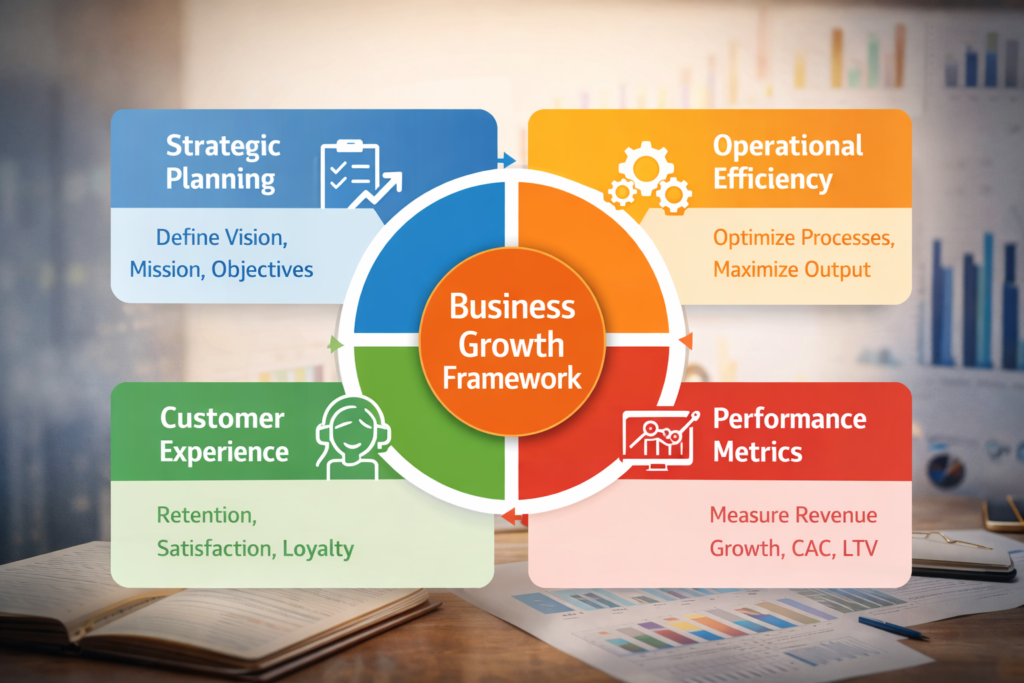
Business growth strategies acts as a structured system to guide companies through scalable growth. It integrates strategy, prosecution, and dimension into a cohesive plan.
Core rudiments of a Growth Framework:
⦁ Strategic Planning: Define vision, charge, and long- term objects.
⦁ Functional effectiveness: Optimize internal processes to minimize costs and maximize affair.
⦁ Client Experience: Focus on client retention and satisfaction as crucial growth motorists.
⦁ Performance Metrics: Measure success through KPIs similar as profit growth, client accession cost, and continuance value.
The part of Analytics:
Analytics help track progress and identify areas for enhancement :
⦁ Deals Analytics:Identify high- performing products and underperforming areas.
⦁ Request Analytics: Cover trends and contender conduct.
⦁ Functional Analytics: Optimize workflows and resource allocation.
Nonstop enhancement:
A strong growth frame emphasizes rigidity. Regularly reviewing and enriching strategies ensures your business remains flexible in a changing request.
Industry-Specific Growth Strategies:
Different industries require tailored approaches to achieve effective business growth. A one-size-fits-all strategy rarely works, so understanding industry nuances is essential.
⦁In the SaaS sector, businesses prioritize customer onboarding, trial-to-paid conversions, and subscription retention. Optimizing the user experience and providing personalized support can dramatically increase recurring revenue.
⦁For retail businesses, growth often comes from expanding e-commerce platforms, hosting pop-up stores, or leveraging influencer marketing. Understanding customer behavior and trends allows retailers to create targeted campaigns that boost both sales and brand loyalty.
⦁Manufacturing companies focus on optimizing supply chains, diversifying product lines, and adopting lean production methods. Efficient operations reduce costs, improve quality, and allow faster scaling in competitive markets.
⦁In the hospitality industry, growth strategies revolve around enhancing customer experience, offering unique services, and expanding into new locations. Online reputation management and digital marketing campaigns also play a critical role.
By customizing strategies according to industry-specific challenges and opportunities, companies can maximize growth potential and achieve sustainable success.
Business Growth Strategies for Modern Enterprises:
Business expansion strategies are specific tactics that companies use to increase request share and profit.
Organic Growth:
Organic growth focuses on expanding being operations naturally.
⦁ Adding deals through marketing juggernauts.
⦁ Enhancing product quality and features.
⦁ Improving client retention through fidelity programs.
Combinations and Accessions( M&A):
Acquiring or incorporating with other businesses can give instant request share and access to new technologies or moxie.
Example: A tech incipiency may acquire a lower AI establishment to accelerate product development.
Franchising and Licensing:
For businesses with strong brand recognition, franchising allows rapid-fire expansion with lower capital expenditure. Licensing intellectual property or technology can also induce profit without functional complexity.
Transnational Expansion:
⦁ Entering global requests requires careful planning
⦁ Understand original regulations and artistic nuances.
⦁ Acclimatize marketing dispatches to original preferences.
⦁ Establish original hookups to streamline logistics and operations.
Actionable Tips to Boost Business Growth in 2026
⦁ Influence Digital Marketing: Focus on SEO, social media, and dispatch juggernauts to attract and retain guests.
⦁ Invest in Talent: Hire professed professionals who align with your growth vision.
⦁ Borrow Agile Practices: Inflexibility allows briskly response to request changes.
⦁ Prioritize client Feedback: Nonstop enhancement should be driven by client perceptivity.
⦁ Monitor Industry Trends: Keep an eye on arising technologies and request shifts to stay ahead.
Strategic Partnerships & Collaborations:
Forming strategic partnerships is a powerful way to accelerate business growth. By collaborating with complementary businesses or industry influencers, companies can unlock opportunities that would be difficult to achieve alone.
⦁Partnerships allow businesses to enter new markets quickly. For example, a local brand partnering with an international distributor can reach customers globally without heavy upfront investment.
⦁Collaborations also enhance brand credibility. Associating with trusted partners or recognized industry figures builds customer trust and increases visibility. Co-marketing campaigns, joint events, or shared content are effective ways to leverage this credibility.
⦁Smaller businesses, in particular, benefit from partnerships by accessing resources and expertise they may not have internally. This can include technology, talent, or marketing capabilities that help scale operations efficiently.
Moreover, strategic alliances encourage innovation. By exchanging ideas, sharing insights, and pooling resources, businesses can develop new products or services that meet evolving customer needs.
When executed thoughtfully, partnerships and collaborations become a key component of modern business growth strategies, driving sustainable success and long-term value.
Common risks to Avoid:
While enforcing growth strategies, businesses must be apprehensive of common miscalculations.
Overexpansion:
Expanding too snappily without sufficient coffers can strain operations and affect quality.
Ignoring data:
Opinions without data- driven perceptivity frequently lead to missed openings and wasted investment.
Neglecting Core capabilities:
Fastening solely on growth while ignoring the strengths that erected the business can weaken your brand and client trust.
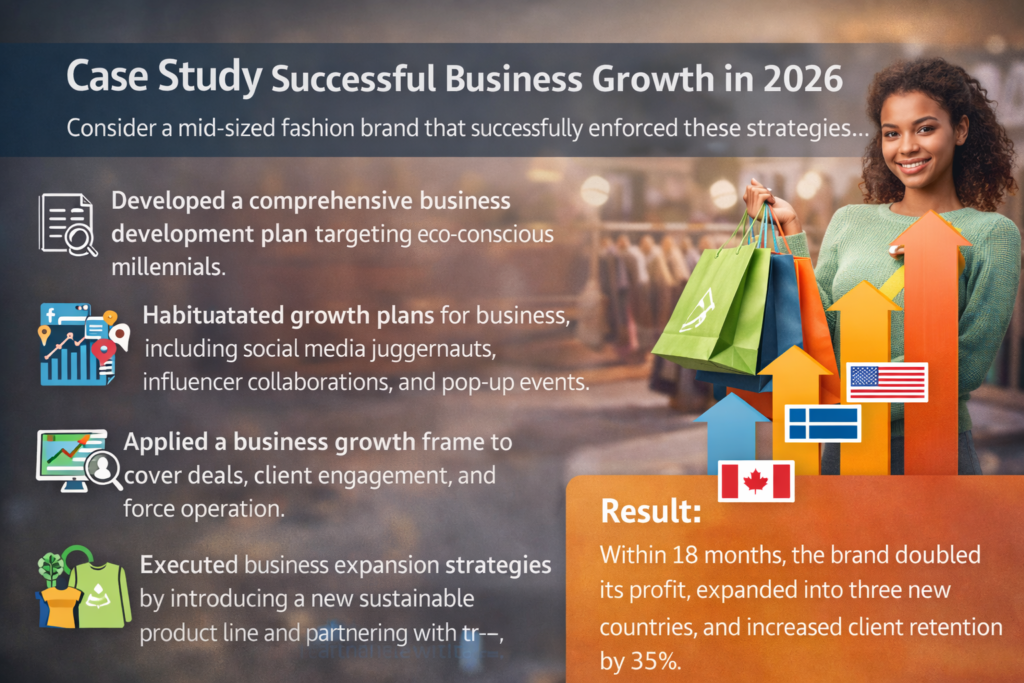
Case Study Successful Business Growth Strategies in 2026
Consider amid-sized fashion brand that successfully enforced these strategies :
⦁ Developed a comprehensive business development plan targetingeco-conscious millennials.
⦁ Habituated growth plans for business, including social media juggernauts, influencer collaborations, and pop- up events.
⦁ Applied a business growth frame to cover deals, client engagement, and force operation.
⦁ Executed business expansion strategies by introducing a new sustainable product line and partnering with transnational retailers.
Result: Within 18 months, the brand doubled its profit, expanded into three new countries, and increased client retention by 35.
Conclusion: The Path to Sustainable Business Growth
In 2026, business growth strategies are no longer voluntary — they are a necessity. A well- drafted business development plan, practicable growth plans for a business, and a strong business growth frame give the roadmap for success. Coupled with smart business expansion strategies, companies can achieve sustainable growth while maintaining quality, effectiveness, and client satisfaction.
Businesses that invest in strategy, influence technology, and remain adaptable to request changes wo n’t only survive but thrive in the competitive global geography. Flash back, growth is n’t just about adding profit — it’s about erecting a flexible, innovative, and unborn-ready association.






Leave a Reply