


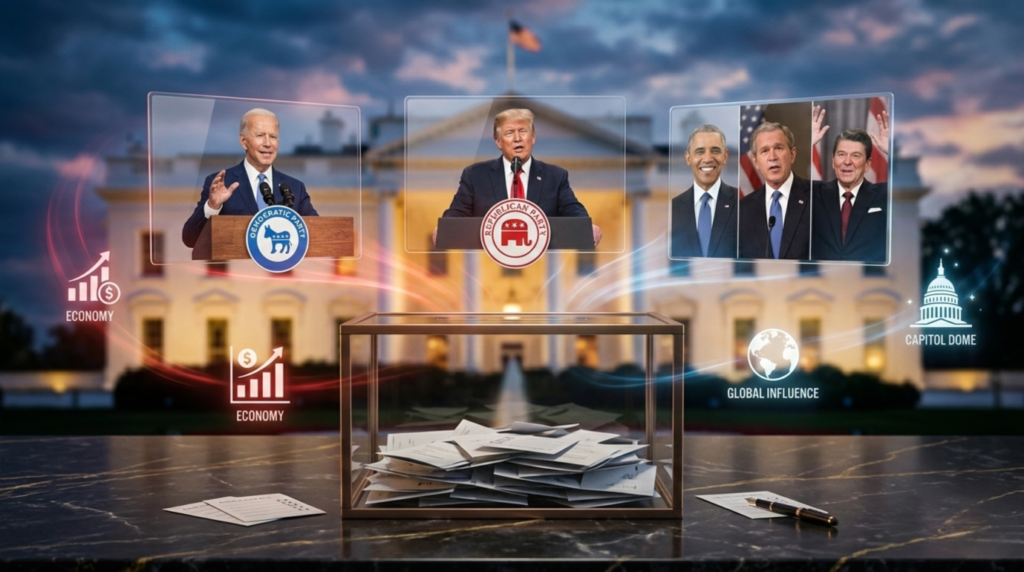
The globe of American politics can appear complicated, full of special terms, historic context,
and enthusiastic debates. From the every night information to social media feeds,
discussions concerning the government’s structure and the beliefs of major political
celebrations are constant. Understanding these core components is crucial to understanding
the headlines and participating in the public process.
This guide will break down the essential elements of the USA political system. We will
certainly explore the structure of its federal government, the roles of its various branches, the
thoughtful distinctions between its major parties, and the really definition of its political
identification. By the end, you’ll have a clearer photo of just how all of it mesh.
The Foundation: Who Wrote the Constitution?
To comprehend the US federal government, you need to start at its resource: the
Constitution. This fundamental paper was not created by a bachelor yet was the item of
extreme dispute and concession amongst 55 delegates to the Constitutional Convention in
- Numbers like James Madison, typically called the “Daddy of the Constitution,”
contributed in drafting the structure.
These males gathered in Philadelphia to address the weaknesses of the Articles of
Confederation, the nation’s very first controling file. Their objective was to create a new
system with a stronger main government, however one that also secured individual
freedoms and stopped any kind of single entity from gaining excessive power. The result
was a blueprint for a federal government separated into three co-equal branches, a system
made to withstand and adjust.
Types of Government: Where Does the US Fit In?
Prior to diving deeper right into the specifics of the American system, it aids to recognize
various types of government. A government is just the system whereby a state or community
is governed. Types can range from monarchies, where a king or queen policies, to
oligarchies, where a little team of people holds power.
An essential distinction is how residents get involved. In some systems, citizens have no
say. In others, their participation is main. This brings us to the principle of democracy. The
direct democracy definition is a system where people elect on policy efforts straight.
Visualize every person ballot on every law; while pure theoretically, it is not practical for a
big, modern nation.
This is why the United States uses a different version.
Is the United States a Democracy or a Republic?
This question commonly triggers debate, however the solution is that the United States is
both. It is not a straight freedom, but a representative democracy. This indicates people
choose officials to represent their passions and choose on their behalf. The authorities–
presidents, senators, agents– are answerable to individuals who elect them.
At the same time, the US is a constitutional republic. The “republic” component suggests
that the supreme power is held by the individuals and their elected reps, as opposed to a
queen. The “constitutional” component suggests that the federal government’s power is
limited by the supreme law of the land– the Constitution. This framework secures the rights
of minorities from being overridden by the will of the bulk, a crucial attribute that
distinguishes it from a pure democracy where bulk guideline is outright.
The Presidential System and the Three Branches
The U.S. runs under a presidential system, where the head of government is likewise the
head of state– the President. This individual leads the executive branch, which is different
from the legal branch. This separation is a core principle of the American political structure,
designed to create a system of checks and balances.
The Legislative Branch (Congress)
Congress is accountable for developing regulations. It is a bicameral legislature, indicating it
has two chambers:
The House of Representatives: Made up of 435 members, with representation based on
each state’s population. Representatives serve two-year terms.
The Senate: Made up of 100 participants, with two senators from each state despite
populace. Senators offer six-year terms.
For a bill to come to be a law, it has to travel through both chambers before being sent to the
President.
The Executive Branch (The President)
The President is responsible for applying the regulations created by Congress. The
President’s powers are huge and consist of working as commander-in-chief of the armed
forces, bargaining treaties with international countries, and designating cabinet members,
ambassadors, and government courts. The executive branch likewise consists of the Vice
President and the different government departments and firms that execute the day-to-day
features of federal government.
The Judicial Branch (The Courts)
Lots of people wonder, what does the judicial branch do? Its main function is to interpret the
laws of the United States. This branch makes sure that regulations gone by Congress and
actions taken by the President line up with the Constitution.
The judicial branch is headed by the United States Supreme Court, which includes 9
justices. Below it are reduced federal courts, consisting of appellate and area courts. This
branch holds the considerable power of “judicial evaluation,” developed in the site instance
Marbury v. Madison. This permits courts to declare a legislation or executive activity
unconstitutional, properly nullifying it. It is the best look at the power of the various other 2
branches.
The Heart of American Politics: Political Parties
While the Constitution does not state political events, they have come to be central to American politics. Events are companies that share a common belief and job to choose their participants to political office. In the United States, a two-party system has actually long controlled the political landscape.
GOP vs. DNC: The Two Major Players
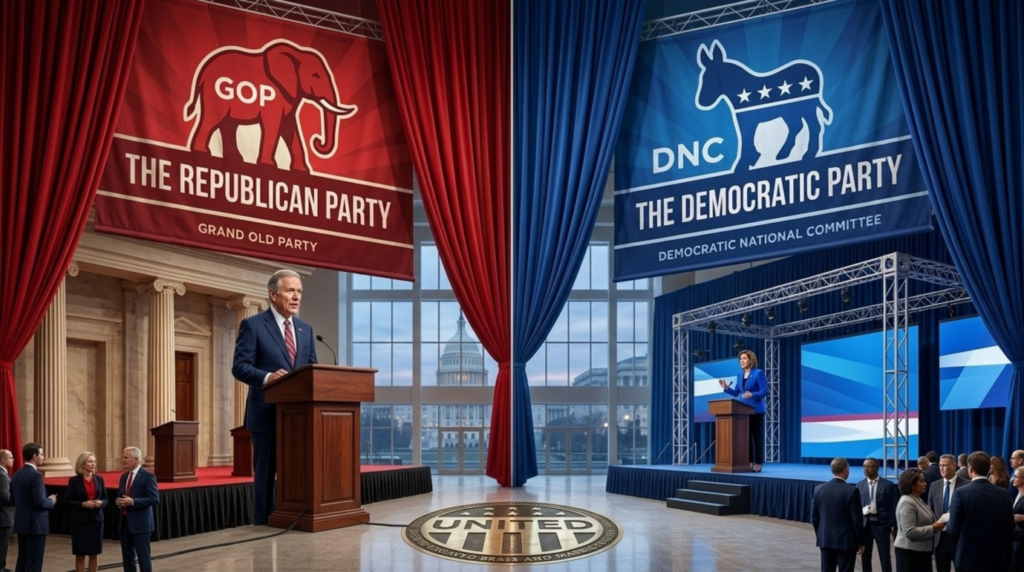
Both dominant events are the Republican Party and the Democratic Party.
The GOP meaning is “Grand Old Party,” a nickname for the Republican Party that has been in usage given that the 1870s. The Democratic Party’s national governing body is the Democratic National Committee, or DNC. The contest in between GOP vs DNC defines the central dispute in modern-day American political elections.
Republican vs Democrat Beliefs: A General Introduction
Understanding the core philosophies of each party is important to grasping political arguments. While specific politicians hold a range of views, the party platforms offer a general guide to their ideas.
Republican Party (GOP) Beliefs
Social Issues: The platform often straightens with socially traditional worths, though views can vary commonly among its members.Typically taken into consideration the a lot more conventional celebration, Republican ideology typically centers on:
Economic Plan: A belief in free-market capitalism, reduced tax obligations, and lowered government spending and law. Republicans argue that this technique cultivates economic growth and specific prosperity.
Limited Government: A core tenet is that the federal government’s role need to be restricted, with even more power devolved to states and people.
Individual Freedom: Emphasis is positioned on personal responsibility and freedom from federal government intrusion.
Strong National Defense: The event typically promotes for an effective armed forces and a robust national safety and security stance.
Democratic Party (DNC) Beliefs
Normally taken into consideration the much more liberal party, Democratic belief frequently centers on:
Financial Policy: An idea that the federal government ought to contribute in resolving inequality and supplying a social safeguard. Democrats tend to support dynamic taxes where higher earners pay a larger portion, investment in social programs like Social Security and Medicare, and stronger guidelines on industries to protect consumers and the environment.
Social Justice and Equality: The party champions civil rights, LGBTQ rights, and gender equality. It actively works to address systemic discrimination.
Environmental Protection: Democrats promote policies to battle climate change, invest in renewable energy, and protect natural resources.
Healthcare: An important goal is expanding access to affordable healthcare, with many supporting a stronger government role in the healthcare system.
The differences in republican vs democrat beliefs create the basic tension in American policy debates. Whether the topic is taxes, healthcare, or climate change, the proposed solutions often reflect these contrasting worldviews.
The Structure in Action: Checks and Balances
The framers of the Constitution were deeply cautious of concentrated power. The system of checks and balances they produced guarantees that no solitary branch can come to be oppressive.
Here are a few examples:
Congress can pass a law, but the President can veto it.
Congress can override a presidential veto with a two-thirds vote in both chambers.
The President appoints Supreme Court justices, but the Senate must confirm them.
The Supreme Court can declare a law passed by Congress and signed by the President to be unconstitutional.
The House of Representatives has the power of impeachment, and the Senate has the power to hold the trial and remove a President or judge from office.
This complex web of overlapping powers forces compromise and deliberation, slowing the pace of change and promoting stability.
A System for the People
The U.S. political structure is a dynamic and often loud machine. It is a representative democracy built on the foundation of a constitutional republic. Power is divided between a presidential system’s executive branch and the legislative and judicial branches, all kept in check by one another.
Within this framework, the ongoing debate between competing ideologies, mainly captured by the GOP vs DNC systems, shapes the nation’s laws and direction. From the fundamental question of is the united states a democracy or a republic to the specific roles of what does the judicial branch do, each element plays a crucial role.
Understanding these elements is more than an academic exercise. It is the key to navigating the complex world of American politics and empowers you to be an informed and engaged citizen in the ongoing project that began in Philadelphia over 200 years ago.
The Evolution of US Foreign Policy
How did a newly formed republic become a global superpower? The answer lies in the foreign policies of U.S. presidents. Over the centuries, American leaders have dramatically shifted their approach to international relations. This guide breaks down the major eras of U.S. global policy, highlighting how different administrations shaped the world.
Early Neutrality to Manifest Destiny
George Washington set a strong precedent of neutrality. He warned against permanent foreign alliances, and this isolationist stance dominated early American politics. However, leaders soon looked outward. Thomas Jefferson expanded borders through the Louisiana Purchase. A few decades later, James Monroe introduced the Monroe Doctrine. This bold policy warned European powers to stay out of the Americas, establishing U.S. influence in the Western Hemisphere.
Stepping Onto the World Stage
The late 19th and early 20th centuries marked a shift toward global intervention. William McKinley led the U.S. into the Spanish-American War, acquiring overseas territories like Puerto Rico and the Philippines. Theodore Roosevelt used “Big Stick” diplomacy to project naval power.
During World War I, Woodrow Wilson tried to “make the world safe for democracy,” eventually pushing for the League of Nations. Later, Franklin D. Roosevelt guided the nation through World War II. His leadership helped establish the United Nations and positioned the U.S. as a dominant global force.
The Cold War Era and Containment
After WWII, Harry Truman introduced the Truman Doctrine to contain Soviet communism. This containment strategy defined global policy for decades. John F. Kennedy navigated the tense Cuban Missile Crisis, avoiding nuclear war.
Later, Richard Nixon shocked the world by opening diplomatic relations with China. In the 1980s, Ronald Reagan took a hardline stance against the Soviet Union. His aggressive military spending and diplomatic pressure helped accelerate the end of the Cold War.
The Modern Era and Complex Diplomacy
Post-Cold War presidents faced entirely new challenges. George H.W. Bush built massive international coalitions for the Gulf War. Following the 9/11 attacks, George W. Bush launched the Global War on Terror, fundamentally altering Middle Eastern relations.
Barack Obama focused on multilateral agreements, such as the Paris Climate Accord and the Iran Nuclear Deal. Donald Trump then pivoted to an “America First” approach, withdrawing from several treaties and renegotiating trade deals. Most recently, Joe Biden has emphasized rebuilding traditional alliances and supporting democratic nations abroad.
Conclusion
U.S. foreign policy continuously adapts to new global challenges. Understanding these historical shifts helps us grasp current international dynamics. To learn more about how specific leaders shaped history, explore detailed biographies of your favorite presidents.






Leave a Reply